
Teenage Mutant Ninja Turtles Draft Guide: The Five Pairs, Ranked by Win Rate
Teenage Mutant Ninja Turtles (TMT) is a small set built on five enemy-color pairs. Each pair has one mechanic and one plan, and the format rewards a fast start more than any recent release. This guide ranks every archetype by real win rate, names the commons that carry decks, and flags the picks the crowd gets wrong.
Every number here comes from our own data: 17Lands game results across 180,204 tracked TMT games, calibrated card ratings, and 7,764 real decks that won 5 or more matches. Where community consensus and the numbers disagree, we say so.
Want the full card ranking as you draft? Both tools score every card in context as you pick.
Format snapshot: fast, and the play matters
The one number that should shape your draft: the on-the-play deck wins 59.4% of games, the on-the-draw deck 54.2%. That is a +5.3 point play advantage, bigger than most Universes Beyond sets. TMT rewards tempo. Curve out, get on the board first, make them react.
Winning decks are creature-dense and lean. The average 5-plus-win deck runs 14.6 creatures and 8.7 noncreatures, about 23 cards total, with roughly 5.3 going to removal. Build toward creatures and interaction, not a durdle pile.
The curve is low. Real winners average 8.4 two-drops, then 5.5 threes, 3.6 fours, 2.6 fives, and only 1.3 at six-plus. Two mana is where the format lives. Leave a pack without a two-drop and you are usually making a mistake.
Two colors is the default, but the multicolor tail is real. 68.3% of winning decks are exactly two colors (counted by mana pips, the honest way), 21.4% run three, and about 10% stretch to four or five. TMT has more real fixing than a typical small set, so the greedy decks exist. Most of the time you still pick two colors and commit.
Mechanics that matter
TMT gives each pair one named mechanic. Learn these four and you know what every archetype is trying to do.
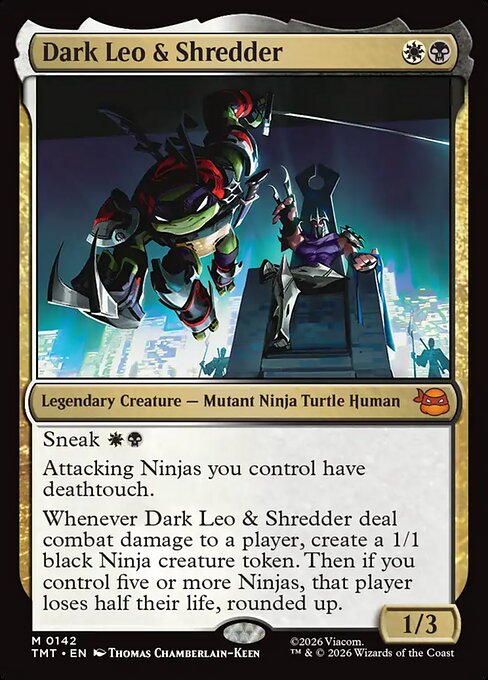
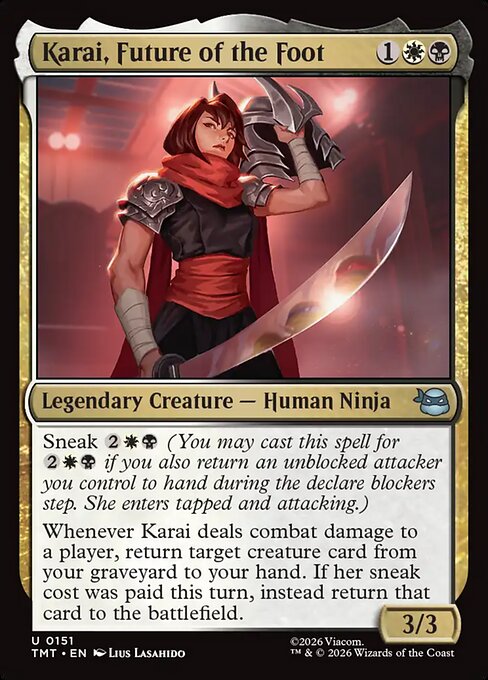
Sneak is the set's ninjutsu. You may cast a Sneak card for its Sneak cost by returning an unblocked attacker to hand during the declare-blockers step. It swaps a chip of damage for a fresh enters-the-battlefield trigger and dodges combat tricks. Twenty-six cards carry it, concentrated in white and black. It anchors WB.
Alliance triggers whenever another creature enters under your control. It is the go-wide payoff, heaviest in red and white, and it is what makes RW an aggro deck rather than a pile of small bodies. Chain cheap creatures, stack the triggers.
Disappear triggers when a permanent leaves the battlefield under your control that turn. It turns sacrifice, tokens, and bounce into value, and it lives in black and green. It is the BG engine.
Mutagen tokens are the artifact glue for the blue-red and green-blue decks. A Mutagen is an artifact you sac for one mana to put a +1/+1 counter on a creature. That single token bridges artifact synergies (UR) and counter synergies (GU), which is why blue sits in the middle of the two most artifact-forward pairs.
Archetype rankings
TMT is a five-pair set, and the five pairs are the five enemy color combinations. That is not marketing framing; it is what the data shows. The five enemy pairs are the five most-drafted and five best-winning decks by a wide margin. Every allied pair (WU, UB, BR, RG, GW) is a fringe deck built around a bomb, not a supported lane.
Ranked by real game win rate. The tracked-population baseline is about 56.8% (17Lands users win above 50%), so read these numbers relative to that, not to a coin flip.
| Rank | Pair | Mechanic | Game WR | On-play WR | Share of 5-win decks |
|---|---|---|---|---|---|
| 1 | WB Orzhov | Sneak | 59.0% | 61.2% | 28.4% |
| 2 | UR Izzet | Artifacts / Mutagen | 58.1% | 60.8% | 26.8% |
| 3 | RW Boros | Alliance | 55.9% | 59.1% | 9.6% |
| 4 | BG Golgari | Disappear | 55.2% | 56.9% | 10.8% |
| 5 | GU Simic | Mutagen counters | 53.2% | 56.2% | 7.2% |
The gap from first to fifth is 5.8 points, large for a five-archetype set. WB and UR are not just the popular decks, they are the good decks: together they carry 55% of all winning decks. Allied pairs sit below. UW posts a 58.6% win rate, but on a tiny sample (1,436 games, 5.8% of winners) and is really a Don-and-Leo splash deck, not a lane. GR (45.7%) and BR (47.1%) are traps.
1. WB Orzhov Sneak (59.0%, the best deck)
Orzhov is the most-drafted and highest-winning pair, and it is the format's spine. Sneak turns your creatures into repeatable value, black brings the deepest removal suite, and white adds evasive bodies and lifegain to grind. It plays like a tempo-attrition deck: apply pressure, trade up with Sneak triggers, and finish with the Foot Clan token engine.
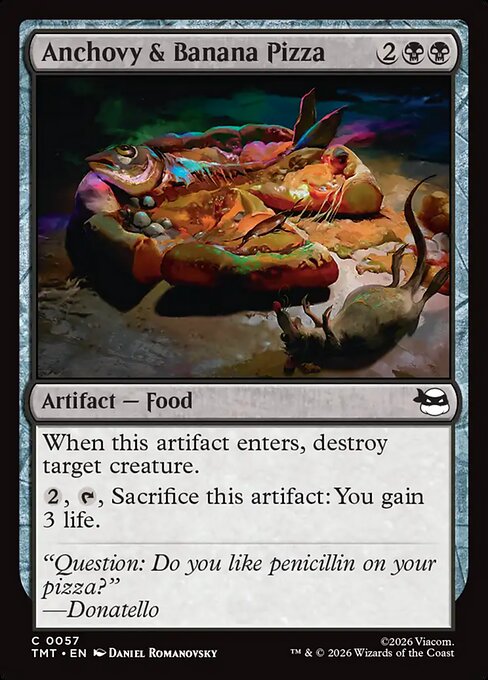
Key cards: Dark Leo & Shredder (WB mythic, 3.36) is the signpost bomb. Karai, Future of the Foot (WB, 3.33) and Splinter, Radical Rat (WB rare, 3.31) reward the ninja plan. Anchovy & Banana Pizza (B common, 3.37, ALSA 3.5) is premium removal on-color. Foot Ninjas (WB common, 3.00, 0.612 win rate) is the common that makes the token engine hum and it wheels.
2. UR Izzet Artifacts (58.1%, tied for the throne, not ahead of it)
Izzet is the artifact-and-Mutagen deck, and its internal synergy is the best in the set. Robot tokens, cheap artifacts, and payoffs that count them stack into a board that snowballs fast. Most community guides crown UR as the format's best deck ("synergy off the charts"). Our data says it is excellent but a hair behind WB: 58.1% to 59.0%, and it wins slightly less on the play. Draft it happily. Do not treat it as the automatic best-in-set.
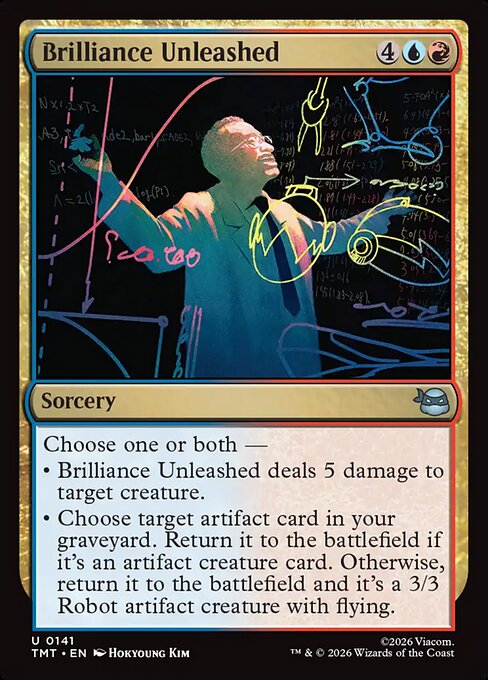
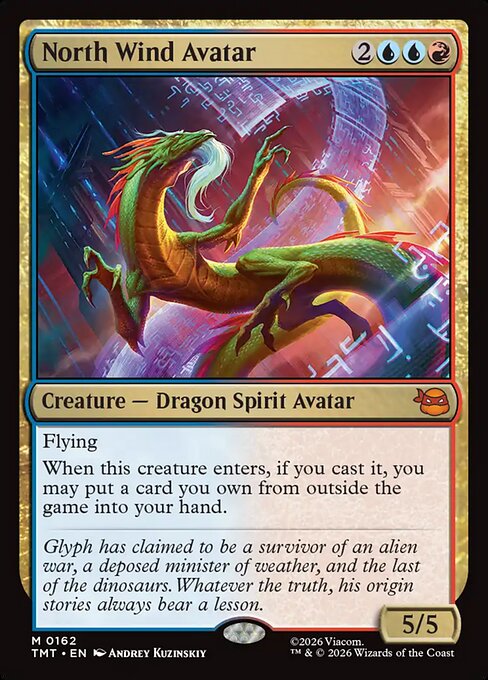
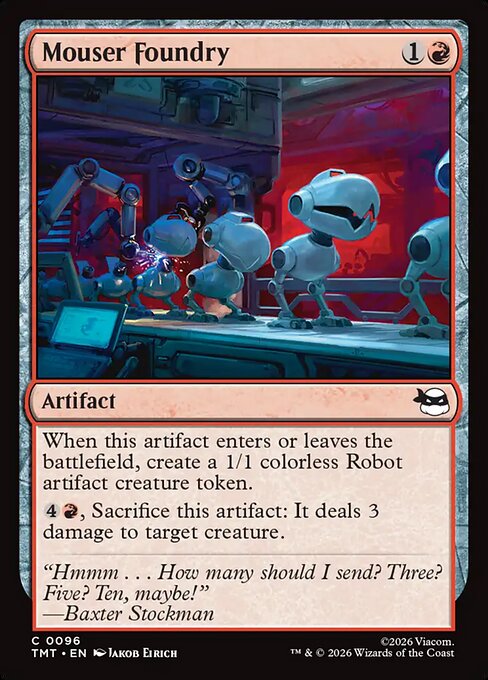
Key cards: Brilliance Unleashed (UR, 3.51) is flexible removal-plus-value. North Wind Avatar (UR mythic, 3.46) and Baxter Stockman (UR, 3.36) are the top-end engines. Mouser Foundry (R common, 3.37, 0.631 win rate) is a token factory that main-decks 80% of the time. Nobody (UR common, 3.24, 0.631) is one of the best commons in the set and it goes around pick 6.
3. RW Boros Alliance (55.9%, the honest aggro deck)
Boros goes wide and hits fast. Alliance turns each new body into a payoff, and the on-the-play win rate (59.1%) is exactly what you want from a curve-out deck in a format this tempo-driven. It is a clear third: strong, but it lacks the raw card quality of the two blue pairs, so it needs the aggression to close before they stabilize.
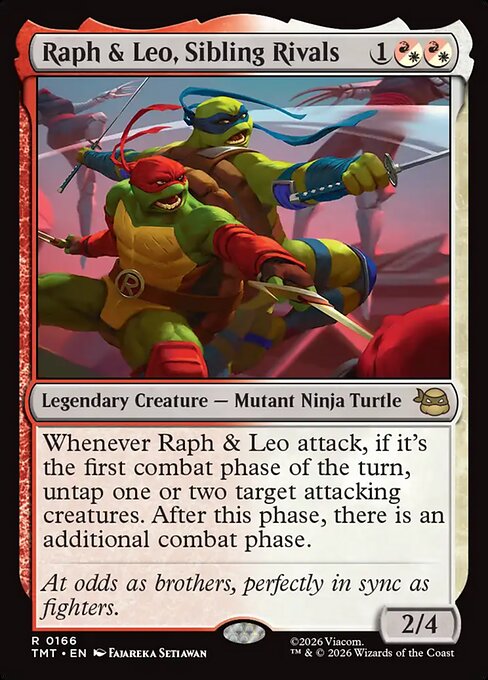
Key cards: Mechanized Ninja Cavalry (RW common, 3.42, the most-played card among winning decks at 52.4%) makes a robot and triggers everything. Raph & Leo, Sibling Rivals (RW rare, 3.29) is the signpost. Manhole Missile (R common, 3.40) is premium burn. Mouser Foundry (R, 3.37) generates the bodies Alliance wants. Prioritize two-drops and reach: do not get cute.


4. BG Golgari Disappear (55.2%, the safe pick the community overrates a step)
Golgari is the value grind: Disappear turns tokens and sacrifice into card advantage, and the deck rarely runs out of gas. Community guides call it "the safest bet." It is safe and it is fine, but at 55.2% it is the fourth-best pair, not the best, and its on-the-play win rate (56.9%) is the lowest of the top four. It grinds well but it starts slow, which is a real cost in a +5.3-play format.
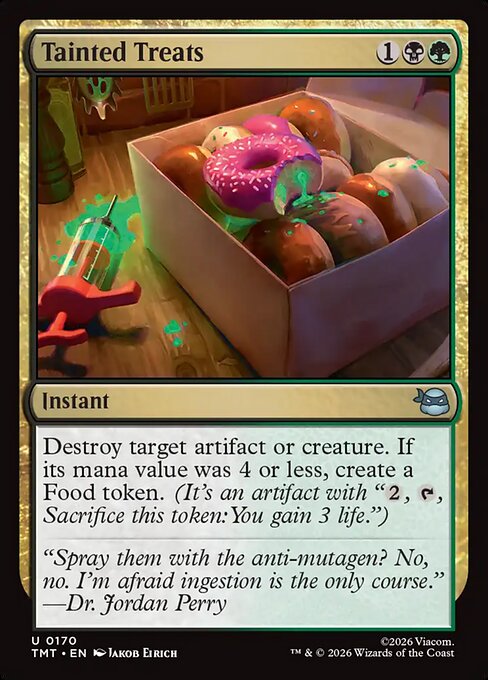
Key cards: The Last Ronin (BG mythic, 3.71, 0.734 win rate, the best card in the set) is a reason to be in these colors. Tainted Treats (BG, 3.49) and Pizza Face, Gastromancer (BG, 3.37) are premium value removal. Ice Cream Kitty (BG common, 3.01) is the free sacrifice outlet that powers Disappear. Frog Butler (G common, 3.55) is the best common in the set and it holds the ground while you grind.


5. GU Simic Mutagen (53.2%, the weak lane the community overrates most)
Simic plays a pile of mutants and grows them with Mutagen counters. On paper it is the sweetest deck. In practice it is the worst of the five, at 53.2%, nearly six points behind WB. Community guides say "blue and green are slightly better" on common quality and talk up Simic's synergy. Our win-rate data flatly disagrees: GU is the bottom archetype, and by a clear margin. The commons are good; the deck is slow, and slow loses the play-advantage race. Draft it when it is open, not because it looks powerful.
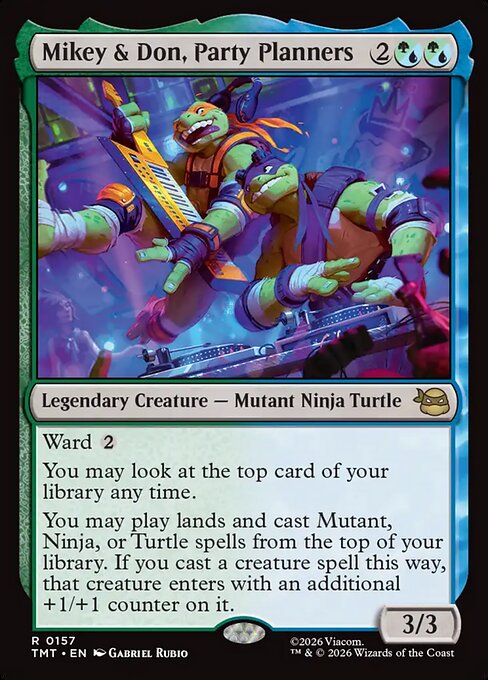
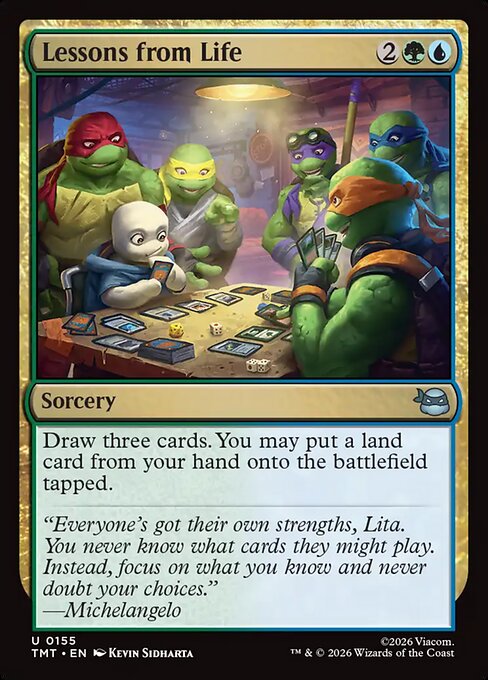
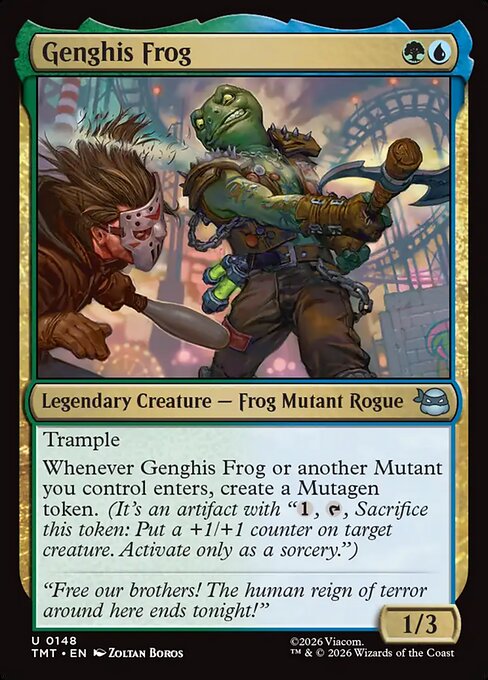
Key cards: Mikey & Don, Party Planners (GU rare, 3.64) is a genuine bomb and the best reason to be here. Lessons from Life (GU, 3.32) and Genghis Frog (GU, 3.26) are the payoffs. Return to the Sewers (U common, 3.10, 0.640 win rate) is the best common Mutagen-maker and it wheels absurdly (ALSA 7.3). Primordial Pachyderm (G common, 3.18, 0.632) is efficient stabilization.
Best commons by color
Commons are the backbone of every pick order. These are the ones that win games, ranked by our calibrated base rating with game win rate noted. For the full list, use the TMT tier list.
White - April O'Neil, Kunoichi Trainee (3.29): the best white common, a two-drop that main-decks 80% of the time. - Uneasy Alliance (3.29): flexible removal at a 0.618 win rate, taken around pick 5. - Leonardo, Big Brother (3.18) and Grounded for Life (3.04): a solid body and a clean answer.
Blue - Buzz Bots (3.34): flying, vigilance, and a card when it dies. The best blue common. - Sewer-veillance Cam (3.28): 0.653 win rate, the highest of any common in the set, and you can run copies. Most guides call it the best common overall; the win rate backs the hype. - Donatello, Turtle Techie (3.19) and Return to the Sewers (3.10): value engines that wheel.
Black - Anchovy & Banana Pizza (3.37): the best black common, premium removal taken at ALSA 3.5. - Stomped by the Foot (3.34): efficient removal, main-decked 80% of the time. - Oroku Saki, Shredder Rising (3.22) and Squirrelanoids (3.21): sticky bodies that feed the sacrifice plans.
Red - Manhole Missile (3.40): the best red common, burn that doubles as removal. - Mouser Foundry (3.37): a token factory that fits both red pairs. - Raphael, Tough Turtle (2.85): the best Alliance common, unexciting but functional.
Green - Frog Butler (3.55): the best common in the entire set, a deathtouch blocker that is also a five-color mana fixer. - Tenderize (3.34): green removal at a 0.631 win rate. - Primordial Pachyderm (3.18) and Ragamuffin Raptor (3.15): efficient midrange bodies that wheel to pick 7.
Removal guide
Winning decks run 5.0 to 5.3 removal spells. Get there. This is a tempo format, so answers that trade up and keep you ahead on board matter more than raw card advantage.
The best removal, by rating: - The Last Ronin (BG mythic, 3.71): removal, a body, and a game-ender in one. - Armaggon, Future Shark (B rare, 3.56) and Metalhead (U uncommon, 3.54): premium single-color answers. - Brilliance Unleashed (UR, 3.51) and Turncoat Kunoichi (W rare, 3.50): flexible modal removal. - Tainted Treats (BG, 3.49), Shredder's Technique (B, 3.45), Dimensional Exile (W, 3.43): uncommon workhorses.
The premium commons are your removal base: Manhole Missile (R, 3.40), Anchovy & Banana Pizza (B, 3.37), Tenderize (G, 3.34), Stomped by the Foot (B, 3.34), Uneasy Alliance (W, 3.29). Black and red carry the most efficient commons, which is one more reason WB and UR sit on top.
Special Guest note: Path to Exile and Umezawa's Jitte are reprints, rare enough to carry no 17Lands sample here, but format-warping when you open them. Take them.
Skip the traps: Mutant Chain Reaction (G, 2.52), Turtles in Time (U mythic, 2.47), and Jennika's Technique (R, base 2.52) rate at or below replacement despite the flashy names. They read as removal. They cost you tempo you cannot afford.
Mana, fixing, and splashing
TMT gives you more fixing than a small set usually does, and the winning decks use it. Real 5-plus-win decks average 1.64 nonbasic fixing lands and about 1.3 mana-producing nonlands. 31.6% of winners run three or more colors by mana pips. Heavy multicolor is a real, if small, tail: about 10% of winners reach four or five colors, usually to jam every bomb they open.
That said, the median winner is still a clean two-color deck, and the play-advantage math punishes stumbling manabases. Splash for genuine bombs, not for a third color's worth of playables.
The real fixers are the artifact rocks and one green creature: Weather Maker, Transdimensional Bovine, Omni-Cheese Pizza, Mona Lisa, Science Geek, and Frog Butler all tap for any color. Frog Butler is the standout because it is a premium common in its own right, so it fixes without costing you a card. Draft your fixing when the lane is set and you have a splash target worth casting.
Overrated and underrated
This is where context beats raw stats. Some cards get taken early and lose; some wheel and win.
Underrated (taken late, win a lot): - Return to the Sewers (U, ALSA 7.3, 0.640 win rate): a top-tier win rate on a common that reliably wheels past pick 7. - Omni-Cheese Pizza (colorless, ALSA 7.1, 0.639) and TCRI Building (colorless, ALSA 7.5, 0.637): fixing and utility the table gives away. - Mutant Town (colorless land, ALSA 7.3, 0.633): a near-free upgrade over a basic. - Nobody (UR, ALSA 6.6, 0.631) and Illegitimate Business (colorless, ALSA 7.1, 0.626): value pieces drafted a full pick too late. - Primordial Pachyderm (G, ALSA 7.0, 0.632): quietly one of green's best commons.
Overrated (taken early, underdeliver): - Raphael, Ninja Destroyer (R mythic, ALSA 2.6, 0.506 win rate): a first-pick reputation and a win rate below the format baseline by ten points. The single biggest name-versus-result gap in the set. - Raph & Leo, Sibling Rivals (RW rare, ALSA 1.3, 0.579): near-first-picked, wins like a middling common. - Turtle Van (colorless rare, ALSA 0.7, 0.590) and Leader's Talent (W rare, ALSA 0.9, 0.595): taken pick one, deliver pick-fifteen results. - Prehistoric Pet (W rare, ALSA 2.0, 0.581) and Cool but Rude (R rare, ALSA 3.3, 0.546): rares the crowd values above the on-color removal that actually wins.
The pattern: TMT rewards curve, tempo, and removal over marquee rares. Score against the pool you've already drafted, and it will flag the flashy mythic that's worse for your deck than the common that wheels.
Quick-start checklist
- Get on the board first. The play advantage is +5.3 points, the biggest lever in the format.
- Draft creatures and curve low. Aim for ~15 creatures peaking at eight two-drops.
- Take 5-plus removal spells. Prioritize the efficient ones that keep you ahead on tempo.
- Read the enemy pairs. WB Orzhov and UR Izzet are the best and most open; ride them when they are there.
- Do not force GU Simic. It looks sweet and it is the weakest of the five.
- Stay two colors by default. Splash only for a bomb, and lean on the artifact rocks and Frog Butler for fixing.
- Value wheeling commons (Return to the Sewers, Nobody, Primordial Pachyderm) above their pick numbers.
More set guides
Drafting something else this week? Same data, same honesty, for every set we cover: Lorwyn Eclipsed, Secrets of Strixhaven, and Marvel Super Heroes.
Sources
Our numbers come from the project's own artifacts: calibrated 17Lands ratings, co-occurrence data, deck and draft targets, and real 5-plus-win baselines for Teenage Mutant Ninja Turtles. Community guides consulted for mechanics framing and consensus, none quoted at length:
- "Teenage Mutant Ninja Turtles Draft Guide." Card Game Base, cardgamebase.com/tmnt-draft-guide/. Accessed 19 July 2026.
- "Teenage Mutant Ninja Turtles Draft Guide." Card Kingdom, blog.cardkingdom.com/teenage-mutant-ninja-turtles-draft-guide/. Accessed 19 July 2026.
- "Teenage Mutant Ninja Turtles (TMT) Draft Guide and Archetypes." Untapped.gg, mtga.untapped.gg/limited/draft/teenage-mutant-ninja-turtles/set-guide. Accessed 19 July 2026.
- "Teenage Mutant Ninja Turtles (TMT) Limited Archetypes Guide." MTG Arena Zone, mtgazone.com/teenage-mutant-ninja-turtles-tmt-limited-archetypes-guide-and-example-decks/. Accessed 19 July 2026.
- "Teenage Mutant Ninja Turtles Prerelease Guide." Wizards of the Coast, magic.wizards.com/en/news/feature/teenage-mutant-ninja-turtles-prerelease-guide. Accessed 19 July 2026.
- "The Ultimate Guide to Teenage Mutant Ninja Turtles Draft." Draftsim, draftsim.com/mtg-tmnt-draft-guide/. Accessed 19 July 2026.
MTG Drafts is an unofficial fan tool, not affiliated with or endorsed by Wizards of the Coast, Nickelodeon, or Paramount Skydance.