
Marvel Super Heroes Draft Guide: Ten Pairs, Ranked by What Winners Drafted
Marvel Super Heroes (MSH) is a good-cards format wearing a synergy costume. Ten color pairs, one mechanic per pair, and a draft that rewards rate and interaction over any single build-around. This guide ranks the ten lanes by what winning drafters actually ended up playing, names the commons that carry decks, and flags the picks the crowd overpays for.
One honesty note up front, and it matters. MSH is a draft-only data set for us: no game-replay data yet, so no per-card game win rates and no archetype win rates from games. Every number below comes from draft behavior: 9,731 real drafts that won 5-plus matches, the cards those winners drafted, calibrated pick-order ratings, and co-occurrence from reconstructed maindecks. That tells you what winning drafters picked and played, not how often each card won a game it was in. Treat these rankings as a pick-behavior signal, not a win-rate table. When game data lands, we will revisit.
Want the full card ranking as you draft? Both tools score every card in context as you pick.
Format snapshot: rate over synergy, and it splashes
The one number that should shape your MSH draft: winning pools average 2.84 nonbasic fixing lands and 1.26 nonland mana producers. This is a splashy, fixing-rich format. The community's "2.5-color" label fits: fixing is plentiful, bombs are worth reaching for, and good decks bend their manabase to play the best cards rather than stay rigidly two-color. The opposite of a tight tribal set.
Creatures still come first. Winning drafters take 23 creatures and 14 other spells across a 42-pick pool. The curve peaks flat at two and three mana (11 slots each), tapers at four (7), and thins fast past five. Build low. Every community guide agrees: play good cards, keep the curve down, run enough interaction. Our numbers back it: white is the deepest color, the top pair is rate-driven midrange, and the hard synergy lanes sit lower.
Removal is plentiful. Winning pools carry 5.7 removal spells, and the set's removal list runs long and efficient. Finding answers is easy. Finding cheap ones is the actual test, so prioritize accordingly.
Mechanics that matter
Power-up. An activated ability creatures use once, cheaper if fired the turn they land, always adding +1/+1 counters plus a bonus. It drives the aggressive green-red end of the format. Low build-around tax: a power-up creature is fine even in a deck with zero payoffs.
Teamwork. Tap untapped creatures with total power at or above a number to unlock an extra effect. It is the Azorius (WU) glue, rewarding a wide, slightly go-tall board. The catch: tapping your team costs you on defense, so teamwork wants to be the aggressor.
Connive. Draw, discard, and add a +1/+1 counter if you pitch a nonland. Card selection stapled to a growth counter, anchoring the Dimir (UB) grind deck. It quietly feeds everything that cares about counters or graveyards, which is why it shows up as a support mechanic well outside UB.
Heroes and Villains. The set's tribal spine. Heroes cluster in white and green (the GW lane), Villains in black and red (the BR lane), bridged by a big neutral mass of Humans and artifacts. The payoffs are real but soft: aim for critical mass, not an all-in engine.
Artifacts. Roughly a quarter of the set is artifacts, and the Izzet (UR) lane keys off density. Even outside UR, artifact count feeds equipment, robots, and a handful of "when an artifact enters" payoffs. Track it the way ECL players track tribal count.
Archetype rankings
Ranked by share of winning drafts: how often winning 5-plus-match drafters ended up in each pair. It blends how open a lane is with how well it converts, the best archetype signal we have without game data. It is not a win rate: a popular lane can be popular because it's safe and deep, not because it wins the most per game. Read it as "where the wins pooled," and weigh it against the card-quality notes below.
| Rank | Pair | Theme | Mechanic | Share of 5-win drafts |
|---|---|---|---|---|
| 1 | WU | Teamwork midrange | Teamwork | 29.3% |
| 2 | WG | Heroes | Hero synergy | 13.8% |
| 3 | WB | Attack alone | Lone-attacker payoffs | 9.3% |
| 4 | UB | Connive / value | Connive | 9.1% |
| 5 | UG | +1/+1 counters | Counter payoffs | 8.8% |
| 6 | UR | Artifacts | Artifact density | 6.9% |
| 7 | BG | Graveyard | Two-plus creatures dead | 6.6% |
| 8 | WR | Noncreature spells | Spell payoffs | 6.4% |
| 9 | BR | Villains | Villain synergy | 5.5% |
| 10 | RG | Power-up stompy | Power-up | 4.2% |
White is in the top three pairs, and four of the top eight. Not an accident: white is the deepest color in the set by card rating (top-10 common-and-uncommon mean base rating of 3.33, ahead of black 3.23, blue 3.20, green 3.16, and red a distant 2.97). Red is the shallowest color, and its two heaviest lanes, BR and RG, sit at the bottom. Undecided at pick three? White is the safest first commitment in the format.
1. WU Teamwork (29.3% of winning drafts, the default best deck)
Azorius midrange is where nearly a third of winning drafters landed. Not a hard synergy deck: white's deep, high-floor commons plus blue's card advantage and tempo, with teamwork as a bonus, not a requirement. Both colors are strong, the curve is easy to fill, and the deck punishes stumbles. It's the "draft good cards, play interaction, curve out" plan the whole format rewards, in its two best colors.
Key cards: King T'Challa // Black Panther, Hope Enduring (WU mythic, 3.43) is the premier gold bomb. Spider-Woman, Secret Agent (WU uncommon, 3.41, removal) is a genuinely first-pickable signpost. The Mighty Thor, Jane Foster (WU rare, 3.32) and Captain America, Living Legend (WU uncommon, 3.14) reward the wide board. Back them with white's common core (below) and blue's card filtering.


Where we differ from the community: several guides crown GW Heroes as the best-supported archetype. On synergy density, they're right, GW has the tightest tribal package. But winning drafters pooled into WU more than twice as often as GW (29.3% vs 13.8%), and WU's on-color cards rate higher. The rate-driven blue-white deck, not the synergy-driven green-white one, is where the wins landed. Caveat stands: this is pick behavior, not game win rate. Read it as "WU was the more reliable landing spot," not "GW is a trap."
2. WG Heroes (13.8%, the synergy pick the community loves)
Selesnya Heroes is the format's most cohesive build-around. Around four in five of your creatures end up Heroes, and the payoffs stack: triggers when a Hero enters, anthem effects, go-wide closers. It's the second-most-popular winning lane, and the community's consensus number one. We have it second, one rank behind WU, because the good-cards blue-white deck converts a hair more reliably. Draft it happily when the Hero payoffs are flowing.
Key cards: Jennifer Walters // The Sensational She-Hulk (WG mythic, 3.46) is the bomb. Spider-Man, To the Rescue (WG uncommon, 3.30) and Black Panther, Vanguard (WG uncommon, 3.06) are the tribal signposts. Storm, Windrider (WG rare, 3.26) tops the curve. Lean on white's two-drops and Undercover Skrull (green's best common, and a fixer) to hold the tribe together.


3. WB Attack Alone (9.3%, better than its reputation)
Orzhov rewards attacking with a single creature: lifedrain, counters, and evasion payoffs that fire when you swing solo. Community guides are split: some rank it near the top, some flag "attack alone" archetypes as historically underwhelming. Our winner-share splits the difference, third overall and comfortably ahead of the mid-pack lanes. It leans on white's depth and black's removal, which is why it holds up better than a narrow gimmick should. The synergy is a bonus on a solid two-color removal-midrange base.
Key cards: U.S.Agent, John Walker (WB uncommon, 3.30) is the signpost. Cloak and Dagger, Entwined (WB rare, 3.10) and Black Widow, Double Agent (WB uncommon, 2.82) reward the lone attacker. Back them with black's premium removal commons (Cruel Alliance, Hour of Defeat) and white's core.


4. UB Connive / value (9.1%, the grind deck)
Dimir is the format's control-lean value deck: connive to filter and grow, Villain creatures that pay off on entry and death, recursion and lifedrain to close. It grinds. The signpost gold cards are on the weaker side (UB's best gold card rates just 2.88), so this deck wins on commons and removal, not marquee synergy pieces. Draft it when the connive enablers and black removal are open.
Key cards: Kang, Temporal Tyrant (UB uncommon, 2.86) and Taskmaster, Mercenary Mimic (UB rare, 2.88) are the signposts. Ghost, Spectral Saboteur (UB uncommon, 2.66) rounds out the value. The real engine is blue's card selection (Trickster's Stratagem, S.H.I.E.L.D. Deployment Drone) plus black's removal suite.


5. UG +1/+1 counters (8.8%, our clearest disagreement with the community)
Simic counters is where our data parts hardest from the guides. CardGameBase ranks it ninth of ten and calls the payoffs "minor." Our winner-share puts it fifth, ahead of UR artifacts, BG graveyard, WR spells, BR Villains, and RG power-up. Connive and power-up both generate counters as a side effect, so "counters matter" payoffs get fed by half the format's mechanics without forcing anything. That keeps the lane quietly consistent. Caveat stands: fifth-by-winner-share isn't fifth-by-win-rate, and the sample is pick behavior. But the crowd is clearly under-drafting this pair relative to where wins accumulate.
Key cards: The Astonishing Ant-Man (UG rare, 3.00) and Ant-Man, Colony Commander (UG uncommon, 2.73) are the counter payoffs. Absorbing Man (UG rare, 2.96), Moon Girl and Devil Dinosaur (UG rare, 2.89), and Beast, Erudite Aerialist (UG uncommon, 2.73) fill the curve. Pair with green's Go Nuts! (a fight spell that also drops a counter) and blue's connive.


6. UR Artifacts (6.9%, the density deck)
Izzet wants a high artifact count: robots, equipment, and payoffs that scale with how many artifacts you control. It's the most build-around-dependent lane in the middle of the pack, so it can boom or bust depending on how many artifacts wheel to you. When the density is there, it's real. When it isn't, you have a below-rate red deck.
Key cards: Tony Stark // The Invincible Iron Man (UR mythic, 3.26) is the payoff bomb. Iron Man, Master of Machines (UR uncommon, 2.81) and Vision Quest (UR rare, 2.90) reward artifacts. The Vision (colorless rare, 3.67, the highest-rated card in the set) and Iron Man Armor (colorless mythic, 3.62) slot in anywhere but shine here. Count your artifacts before you commit.


7. BG Graveyard (6.6%, trade-and-grind)
Golgari turns dead creatures into resources: payoffs that trigger with two-plus creatures in your graveyard, reached naturally through combat. It's a fine midrange grind deck with a real removal base, but the payoffs are modest and it needs the trades to come. Middle of the pack, drafted less than its raw power suggests.
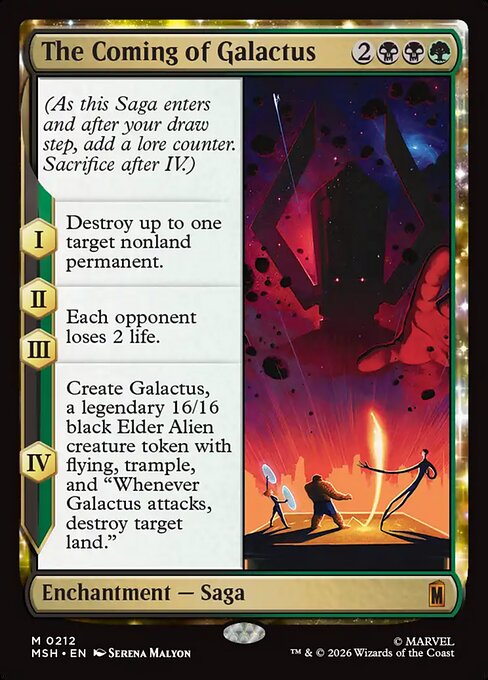
Key cards: The Coming of Galactus (BG mythic, 3.35, removal) is the bomb and one of the best cards in either color. Titania, Rugged Rumbler (BG uncommon, 3.18) and Killmonger, Scourge of Wakanda (BG uncommon, 3.04, removal) anchor the graveyard plan. Green's bodies plus black's removal do the heavy lifting.


8. WR Noncreature Spells (6.4%, the aggressive splash lane)
Boros wants a critical mass of noncreature spells to turn on its payoffs, then closes fast. The gold cards are strong (Monica Rambeau // Photon, Living Light at 3.52 is one of the best signposts in the set), but the archetype demands you skew away from creatures, fighting the format's creature-first grain. High ceiling, awkward floor.
Key cards: Monica Rambeau // Photon, Living Light (WR mythic, 3.52), The Super Hero Civil War (WR rare, 3.50), and Daredevil, Man Without Fear (WR rare, 3.20) headline. War Machine, Legacy of Iron (WR uncommon, 3.09) rewards the spell count. Red's burn (Lightning Strike, Repulsor Blast) doubles as removal and spell fuel.


9. BR Villains (5.5%, weak lane, community agrees)
Rakdos Villains is the aggressive tribal deck: token generation, buffs, and lifedrain that key off Villain cards. Most of your creatures naturally fit the theme, so density is easy, but the payoffs sit at the shallow end of the set and red is the weakest color. Both our data and most community guides put this near the bottom. Draft it when it's open, not by default.
Key cards: The Ruinous Wrecking Crew (BR rare, 3.18, removal), Avengers: Under Siege (BR rare, 3.17, removal), and Bullseye, Death Dealer (BR uncommon, 3.07, removal) carry the deck on removal more than synergy. Ares, God of War (BR rare, 3.02) and Madame Hydra (BR uncommon, 2.95) are the signposts.


10. RG Power-up (4.2%, the weakest lane, and everyone agrees)
Gruul stompy is the purest "big creatures, few payoffs" deck: power-up growth, trample, fights. It's the least-drafted winning lane in the set, and both Draftsim and CardGameBase rank power-up dead last, calling it "basic rate-based" with "minimal synergy." Our winner-share agrees flatly at 4.2%. Red's shallow common pool is the core problem. Reading an open Gruul lane pays off. Forcing it gets you a losing record.
Key cards: Wolverine, Fierce Fighter (RG rare, 3.23, removal), Abomination, Terrifying Titan (RG uncommon, 3.21, removal), and Alien Invasion (RG rare, 3.05) are the power. Ravenous Tyrannosaurus (RG mythic, 3.16) tops the curve when you open it. Green's Undercover Skrull and red's HULK SMASH! fill out the beats.


Best commons by color
Commons are the backbone of every pick order, ranked by our calibrated base rating with maindeck rate noted, so you can see how reliably winners actually played them. Remember: no game win rates here, this is pick-and-play behavior. For the full list, use the MSH tier list.
White (the deepest color, draft it) - Web Up (3.40, removal): white's best common and a top-tier answer. Maindecked 89%. - Hero in Training (3.38): the most-drafted card among winners, a card-advantage creature that fits every white deck. - Murdock's Crusade (3.25, removal) and Brave Brawler (3.25): efficient interaction and a clean body. - Take Up the Shield (3.20) and Helicarrier Strike (3.19, removal): more depth than any other color offers.
Blue - Frozen in Ice (3.33, removal): blue's premier answer, maindecked 87%. - S.H.I.E.L.D. Deployment Drone (3.33): token generation and the connective tissue for teamwork and counters. - Trickster's Stratagem (3.26) and We Say Thee Nay! (3.22): card selection and tempo, both heavily played.
Black - Cruel Alliance (3.33, removal): flexible removal with a teamwork upside, black's best common. - Hour of Defeat (3.31, removal): efficient interaction, taken early (ALSA 3.4). - Red Room Recruit (3.12) and Widow's Bite (3.11, removal): a solid body and more removal depth.
Red (the shallowest color) - Lightning Strike (3.17, removal): red's best common and the color's reason to exist, instant-speed reach. - Repulsor Blast (3.03, removal) and HULK SMASH! (2.93, removal): removal that gets progressively worse but stays playable. - The dropoff after Lightning Strike is steep. Red is a support color here, not a base.
Green - Undercover Skrull (3.29): green's best common, a body that also fixes all five colors. Take it high. - Go Nuts! (3.21, removal): a fight spell that drops a counter and carries teamwork, green's premier interaction. - Green's common depth falls off fast after these two (next best sits at 2.88), so lean on your gold cards and fixing.
Colorless deserves a mention: The Vision (3.67) is the single highest-rated card in the set and goes in any deck, and H.E.R.B.I.E. Scout Unit (colorless common, 3.13) is a maindeck-anywhere role-player that wheels.
Removal guide
Winning pools carry 5.7 removal spells, and the set gives plenty of options. The best removal, by rating:
- Web Up (W, 3.40) and Dark Deed (B, 3.39): the premium efficient answers, commons-and-uncommons you'll see often.
- Super Villain Lockup (W, 3.35), The Coming of Galactus (BG, 3.35), Elektra, Daughter of the Hand (B, 3.33): rare-and-uncommon removal that also brings a body or value.
- Cruel Alliance (B, 3.33), Hour of Defeat (B, 3.31): black's premium removal commons, the deepest interaction base in the format.
- Punishing Punch (G, 3.33) and Epic Fight (G, 3.30): green's fight-based removal, conditional but efficient.
- Mjölnir, Hammer of Thor (R, 3.33) and Thor, God of Thunder (R, 3.31): red's rare-level answers.
- Murdock's Crusade (W, 3.25), Helicarrier Strike (W, 3.19), Lightning Strike (R, 3.17): the common removal that fills out the count.
Black and white carry the most removal depth, one more reason the white-based pairs and black grind decks perform. Red's removal is efficient at the top (Lightning Strike) but thins out fast. Cut the worst pieces (HULK SMASH! and the pricier red sorceries) first once your count is healthy.
Mana, fixing, and splashing
This is where MSH breaks from a tight two-color set. Winning pools average 2.84 nonbasic fixing lands and 1.26 nonland mana producers, and our deck target is 2.5 fixing lands per built deck. The community's "2.5-color" framing holds up: most good decks are a solid two-color base plus a small splash of two to four powerful or synergistic cards.
The fixing is real, and worth drafting for. Prioritize the five-color mana producers: Dependable Quinjet, Doc Samson, Super Psychiatrist, Undercover Skrull (also a fine green two-drop), Stark Industries Executive, Death to Our Enemies, and Ant-Man's Army. Ronin, Shadow Stalker adds conditional five-color fixing. Undercover Skrull is both green's best common and a rainbow fixer, so green splashes are the easiest to support.
The practical rule: pick your two best colors, keep the curve low, and splash only for genuine bombs or key synergy pieces once you've got two-plus sources to cast them. Unlike a hybrid-heavy tribal set, MSH doesn't punish you for reaching, as long as you actually draft the fixing. The bombs are worth it: the Special Guest cards (Sword of Fire and Ice, Path to Exile, Archangel of Thune, Warleader's Call) show up in a small share of packs and are slam-dunk splash targets when they do.
Overrated and underrated
Without game win rates, we lean on a different tell: average pick position versus maindeck rate. Cards taken early that frequently sit in the sideboard are over-drafted for their name. Cards that wheel late but still make the deck are quietly earning their slot. One caveat: gold cards naturally maindeck less because they need both colors, so weigh that when reading the "overrated" list.
Underrated (wheel late, still get played): - Borough Backup (W common, ALSA 5.7, maindecked 78%): a white role-player the table gives away. - Raft Security Officer (W common, ALSA 6.0, 78%): more late white value that consistently makes decks. - H.E.R.B.I.E. Scout Unit (colorless common, ALSA 5.8, 77%): playable in any deck and drafted near the back of the pack. - Red Room Recruit (B common, ALSA 6.4, 77%) and Widow's Bite (B common, ALSA 5.6, 75%): black depth that wheels.
The pattern: white and colorless commons wheel further than their play rate justifies. In white, you can pass early speculation and still assemble a full curve on the wheel.
Overrated (taken early, often benched): - Nick Fury, Agent of S.H.I.E.L.D. (W rare, ALSA 4.4, maindecked just 56%): a rare the crowd takes on name that misses the deck nearly half the time. - Absorbing Man (UG rare, ALSA 2.6, 65%) and Vision Quest (UR rare, ALSA 3.2, 61%): early picks that demand the right shell and frequently sit out. - Cloak and Dagger, Entwined (WB rare, ALSA 1.8, 72%): taken almost first-pick, maindecked less than several commons. A strong card that still gets over-prioritized. - The Kingpin of Crime (WB rare, ALSA 3.2, 61%): a marquee villain that underdelivers on how early it goes.
The lesson MSH keeps teaching: this format rewards rate, a low curve, and enough removal over marquee names. Score against the pool you've already drafted, and it will flag the flashy rare that's worse for your deck than the white common that wheels.
Quick-start checklist
- Draft good cards on a low curve. Aim for around 23 creatures in the pool, curve peaking at two and three mana.
- Start in white when undecided. It's the deepest, safest, highest-floor color in the set.
- Take 5-plus removal. Black and white carry the deepest interaction; red's is efficient but thin.
- WU and WG are where the wins pool. Do not force RG power-up or BR Villains unless they're wide open.
- Draft the fixing. This is a 2.5-color format: pick up rainbow fixers (Undercover Skrull, Dependable Quinjet) and splash your bombs.
- Value white and colorless commons that wheel over early-picked gold rares that miss the deck.
A note on the data
MSH sits in our draft-only data tier. Ratings are bootstrapped from real pick order and maindeck rates, co-occurrence is reconstructed from drafted pools, and there's no game-replay data yet, so nothing here is a game win rate. That's thinner than our game-data sets, and we'd rather say so than dress pick behavior up as win percentage. The signal is still strong: 9,731 winning drafts is a large sample of what actually gets picked and played. When game data arrives, the archetype order and the overrated/underrated calls are the first things we'll re-check.
More set guides
Drafting something else this week? Same data, same honesty, for every set we cover: Lorwyn Eclipsed, Secrets of Strixhaven, and Teenage Mutant Ninja Turtles.
Sources
Our numbers come from the project's own artifacts: calibrated pick-order ratings, reconstructed co-occurrence, draft targets, and real 5-plus-win draft baselines for Marvel Super Heroes. Community guides consulted for mechanics framing and consensus, none quoted at length:
- "Exploring All 10 Marvel Super Heroes Limited Archetypes." Draftsim, draftsim.com/mtg-msh-draft-archetypes-6-3-26/. Accessed 19 July 2026.
- "Marvel Super Heroes (MSH) Draft Guide and Archetypes." Untapped.gg, mtga.untapped.gg/limited/draft/marvel-super-heroes/set-guide. Accessed 19 July 2026.
- "Marvel Super Heroes Draft Guide." Card Game Base, cardgamebase.com/marvel-super-heroes-draft-guide/. Accessed 19 July 2026.
- "Marvel Super Heroes Prerelease Guide." Wizards of the Coast, magic.wizards.com/en/news/feature/marvel-super-heroes-prerelease-guide. Accessed 19 July 2026.
- "MTG Marvel Super Heroes Draft Archetypes Guide." NerdSnack, nerdsnack.com/mtg-marvel-super-heroes-draft-guide/. Accessed 19 July 2026.
- "The Ultimate Marvel Super Heroes Limited Set Review." Draftsim, draftsim.com/mtg-msh-limited-set-review/. Accessed 19 July 2026.
MTG Drafts is an unofficial fan tool, not affiliated with or endorsed by Wizards of the Coast, Marvel, or The Walt Disney Company.