
Secrets of Strixhaven Draft Guide: The Five Colleges, Ranked by Win Rate

Secrets of Strixhaven (SOS) is a spells-matter set. Five two-color colleges, a deck that runs about as many noncreatures as creatures, and a format that rewards fixing and tempo. This guide ranks every college by real win rate, names the commons that carry decks, and flags the picks the crowd gets wrong.
Every number here comes from our own data: 17Lands game results for 373,524 tracked SOS games, calibrated card ratings, and the 16,617 real decks that won 5 or more matches. Where the community consensus and the numbers disagree, we say so and show the gap.
Want the full card ranking as you draft? Both tools score every card in context as you pick.
Format snapshot: spells matter, tempo wins
The number that shapes your draft: winning SOS decks run about 11.5 creatures and 11.7 noncreatures, a near-even split, the single biggest difference from a normal creature-first set. Roughly half your maindeck is instants, sorceries, and other noncreatures: the college mechanics pay you to cast spells. You are not just stacking bodies. You are building a spell engine that happens to have a board.
Within those noncreatures, winning decks run 5 removal spells. The curve peaks at two mana (8.0 twos on average), then 5.8 threes, 3.2 fours, 2.2 fives, 1.5 sixes-and-up, with 2.6 ones. Build toward eight two-drops with real removal and you will rarely stumble.
Tempo is the format's engine. The on-the-play deck wins 58.3% of the time versus 53.2% on the draw, a +5.1 point play advantage across the whole format. That is a full point sharper than a grindier set like Lorwyn Eclipsed (+3.9). Spells-matter does not mean slow-and-durdle. The colleges that go under the table win the most. Being on the play matters more here than in most formats. Curve out and apply pressure.
Splashing is normal. Only 58.5% of winning decks are exactly two colors; 41.5% run three or more (counted by mana pips, the honest way). This is a fixing-hungry format. The mana section below is not an afterthought. Plan your splash while you draft, not after.
Mechanics that matter
The five colleges are the format. SOS drops the usual ten pairs for five college pairs, each with a signature mechanic. Silverquill (WB), Lorehold (RW), Prismari (UR), Witherbloom (BG), Quandrix (GU). Off-college pairs (WU, UB, WG, BR, RG) barely exist among winners. Pick a college early and commit.
Prepared is the connective tissue. The set's most common mechanic (38 cards) is Prepared: a creature enters "prepared" with an attached spell, and while it is prepared you may cast a copy of that spell once. These are the double-faced creature-plus-spell cards like Elite Interceptor // Rejoinder. They smooth every draft, count as both a body and a spell, and feed the spells-matter payoffs. Take them a touch higher than raw stats suggest: the flexibility compounds with whatever college you land in.
Repartee (Silverquill): whenever you cast an instant or sorcery that targets a creature, a Repartee ability triggers, usually a +1/+1 counter. It turns your removal and combat tricks into permanent board advantage. It is genuinely hard to draft a coherent WB deck that ignores it.
Opus (Prismari): a modified prowess. A small bump when you cast an instant or sorcery, a much bigger payoff when that spell cost five or more mana. It pulls Prismari toward a heavier, spell-slinging plan.
Infusion (Witherbloom): if you gained life this turn, a creature's controller loses 3 life. It turns incidental lifegain into reach and removal in the grindy BG deck.
Increment (Quandrix): whenever you cast a spell that cost more mana than this creature's power or toughness, it gets a +1/+1 counter. It rewards ramp and big spells, which is exactly Quandrix's plan.
Converge (11 cards) rewards spending many colors of mana to cast a spell (a +1/+1 counter per color, or a scaling effect). It is the format's built-in splash payoff, and it is one more reason SOS decks reach for a third color.
College rankings
Ranked by real game win rate, two-color decks only. The tracked-population baseline is 55.8% (17Lands users win above 50%), so read these numbers relative to that, not to a coin flip. Anything below 55.8% is a below-average deck for the average tracked drafter.
| Rank | College | Colors | Game WR | On-play WR | Share of 5-win decks |
|---|---|---|---|---|---|
| 1 | Lorehold | WR | 58.3% | 60.8% | 23.4% |
| 2 | Silverquill | WB | 57.9% | 61.2% | 20.4% |
| 3 | Quandrix | UG | 55.3% | 58.9% | 9.6% |
| 4 | Witherbloom | BG | 54.8% | 56.6% | 12.7% |
| 5 | Prismari | UR | 54.8% | 57.2% | 24.9% |
The five college pairs are, by a wide margin, the five most-played pairs among winners. Every off-college pair (WU, UB, WG, BR, RG) either sits below 53% or shows up in fewer than 5% of winning decks on samples too thin to trust. The lanes are the lanes.
Two things in that table cut against the crowd, and both are worth real money at the table. Read on.
1. Lorehold WR (58.3%, the format's best deck)
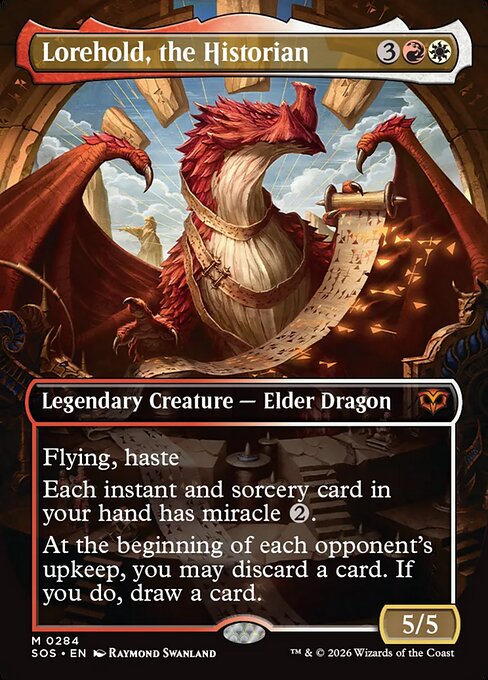
Lorehold is the aggressive graveyard-value deck: efficient creatures, red reach, flashback and graveyard payoffs to grind the long game if the beatdown stalls. It is the best college by win rate and the second-most-popular, and it has the format's tempo profile: get under the spell decks, close before Quandrix ramps or Prismari sets up. Its on-the-play win rate (60.8%) is one of the two highest in the set.
Key cards: Ark of Hunger (RW rare, 3.56, 0.684 win rate) is the best gold card in the college. Lorehold, the Historian (RW mythic, 3.41) is the marquee payoff. Practiced Scrollsmith (RW uncommon, 3.35, 0.649) is the value engine most guides point to first. In-color, Unsubtle Mockery (R common, 3.45) and Tome Blast (R common, 3.38) are premium removal, and Elite Interceptor // Rejoinder (W common, 3.32) is the best white common in the set. Pursue the Past (RW common, 3.04) is a sneaky-good wheel (see overrated/underrated).


2. Silverquill WB (57.9%, the co-best, built on Repartee)
Silverquill is the midrange-aggro tokens-and-removal deck, and Repartee ties it together: every targeted spell becomes a permanent buff. It posts the single highest on-the-play win rate in the set (61.2%), which is what you want from a curve-and-pressure deck. It is essentially tied with Lorehold for best, and it is the third-most-popular college. Draft your removal a hair higher here than usual: in Silverquill, removal is also a +1/+1 counter.
Key cards: Moment of Reckoning (BW rare, 3.37, 0.686) is premium removal that also triggers your Repartee. Conciliator's Duelist (BW rare, 3.19) and Scolding Administrator (BW uncommon, 3.23) are the payoffs. Silverquill Charm (BW uncommon, 3.21) is flexible interaction. In-color, Last Gasp (B common, 3.36) and Wander Off (B common, 3.31) are the best black commons, both efficient removal, and Ajani's Response (W common, 3.24) is a removal spell the table gives away late.


3. Quandrix UG (55.3%, the underdrafted overperformer)
Here is the first place our data breaks from the community. Most guides rank Quandrix last, the slowest college, a durdly ramp-into-fatties deck. Our win rate has it third at 55.3%, a half point clear of both Witherbloom and Prismari. And it is the least-drafted college by a mile: just 9.6% of winning decks, versus 24.9% for Prismari. The crowd is avoiding the deck that quietly wins.
Two caveats keep this honest. Quandrix has the largest play/draw gap in the set (58.9% on the play, 51.7% on the draw, a +7.2 spread), so the ramp deck badly wants to be on the play and punishes a slow start. And its win rate is only a hair above the 55.8% baseline. This is not a broken deck. It is an open, underrated one: when the ramp-and-Increment lane is flowing to you, take it, because few of your neighbors are fighting for it.
Key cards: Quandrix, the Proof (GU mythic, 3.55, 0.665) is the marquee. Applied Geometry (GU rare, 3.41) and Mind into Matter (GU rare, 3.37) are the ramp payoffs. Quandrix Charm (GU uncommon, 3.07, 0.629 win rate at ALSA 5.7) is a genuine steal. In-color, Studious First-Year // Rampant Growth (G common, 3.29) is the ramp two-drop and Noxious Newt (G common, 3.27) anchors the ground. Essence Scatter (U common, 3.20) is your counter.


4. Witherbloom BG (54.8%, the awkward middle)
Witherbloom is the grindy lifegain-drain deck built on Infusion. It plays an awkward middle ground: too slow to go under Lorehold and Silverquill, not powerful enough at the top to out-durdle Quandrix and Prismari. At 54.8% it is a hair below the 55.8% baseline, so it wins slightly less than the average tracked drafter. It is a real deck with a deep removal suite, but it is a commit-only-when-open lane, not a default.
Key cards: Professor Dellian Fel (BG mythic, 3.51, 0.669) is a bomb and near the top of the set. Vicious Rivalry (BG rare, 3.32) and Grapple with Death (BG common, 3.33) give the deck removal at every rarity. Essenceknit Scholar (BG uncommon, 3.26) and Blech, Loafing Pest (BG rare, 3.25) reward the plan. In-color, lean on Last Gasp and Wander Off in black and Studious First-Year, Noxious Newt, and Burrog Barrage (G common removal, 3.07) in green.


5. Prismari UR (54.8%, the popular trap)
Here is the second and bigger disagreement with the crowd. Prismari is the most-drafted college in the set (24.9% of winning decks, more than any other pair) and it wins at a tied-for-last 54.8%, below the 55.8% baseline. The crowd's favorite is a below-average deck. The spell-slinging Opus plan is fun and it has the highest card ceiling (Crackle with Power, the Traumatic Critique package), but the average Prismari deck underdelivers: it leans on a critical mass of expensive spells that does not always come together.
This does not mean never draft Prismari. It means do not default into it because it looks open. It always does, because everyone is in it. If you are in UR, commit to the removal-and-tempo build over the durdly big-spell build, and get on the play.
Key cards: Crackle with Power (R mythic, 3.64, 0.709, the best win rate in the set) is a first-pick bomb. Traumatic Critique (UR rare, 3.52), Colorstorm Stallion (UR rare, 3.51), Splatter Technique (UR rare, 3.46), and Stress Dream (UR uncommon, 3.49) are the removal-heavy backbone. Expressive Iteration (UR rare, 3.38) is the card-advantage engine. In-color, Unsubtle Mockery and Tome Blast in red and Essence Scatter and Run Behind (U common, 3.11) in blue.


Best commons by color
Commons are the backbone of every pick order. These are the ones that win games, ranked by our calibrated base rating with game win rate noted. For the full list, use the SOS tier list.
White - Elite Interceptor // Rejoinder (3.32): a Prepared body plus a spell, main-decked 83% of the time. The best white common. - Ajani's Response (3.24): removal that wheels to ALSA 5.4 for a 0.631 win rate. - Stone Docent (3.10) and Shattered Acolyte (2.94): solid white bodies that hold the curve.
Blue - Essence Scatter (3.20): the counter every blue deck wants. - Run Behind (3.11): a tempo play with a 0.629 win rate that goes around pick 7. - Hydro-Channeler (3.05): a body that also fixes and ramps, key to the blue decks.
Black - Last Gasp (3.36): the best black common, cheap efficient removal, main-decked 84%. - Wander Off (3.31): more clean removal, and it wheels less than it should. - Melancholic Poet (3.11) and Cost of Brilliance (2.88): grind and card advantage.
Red - Unsubtle Mockery (3.45): the best common in the set, red removal main-decked 88% of the time. - Tome Blast (3.38): more premium removal, the second-best common. - Rubble Rouser (3.19) and Heated Argument (3.07): a beater and burn; Heated Argument wheels to pick 7.
Green - Studious First-Year // Rampant Growth (3.29): a Prepared body that ramps, the best green common. - Noxious Newt (3.27): the ground-holder green wants. - Burrog Barrage (3.07): green removal at a 0.617 win rate, and it wheels to ALSA 6.6.
Note the shape: red and black carry the most premium removal at common, white leads on flexible Prepared bodies, and green and blue lean on enablers. Red and black commons are the deepest, which is one more reason Lorehold and Silverquill sit on top.
Removal guide
Winning decks run 5 removal spells. Get there. Removal is doubly good in SOS because Repartee and combat-trick payoffs turn your targeted spells into board advantage, so the color pairs that want removal really want it.
The best removal, by rating: - Together as One (C rare, 3.63, 0.708): a colorless removal-plus-value spell playable in any deck and a near-first-pick. - Winds of Abandon (W mythic, 3.57) and Moment of Reckoning (BW rare, 3.37): premium white-based answers that also swing tempo. - Traumatic Critique (UR, 3.52), Splatter Technique (UR, 3.46), and Stress Dream (UR, 3.49): the Prismari removal package, the reason the deck's ceiling is real even if its floor is not. - Professor Dellian Fel (BG, 3.51) and Subterranean Tremors (R mythic, 3.45): removal attached to a threat or a sweeper. - Cyclonic Rift (U, 3.44) and Bitter Triumph (B, 3.39): flexible answers with reach.
The premium commons are your removal base: Unsubtle Mockery (R, 3.45), Tome Blast (R, 3.38), Last Gasp (B, 3.36), Wander Off (B, 3.31), Ajani's Response (W, 3.24), Grapple with Death (BG, 3.33), Wilt in the Heat (RW, 3.12), and Burrog Barrage (G, 3.07). Red and black carry the most efficient commons, which is one more reason those colors show up in the best colleges.
Skip the traps: Harsh Annotation (W, 2.53), Chelonian Tackle (G, 2.60), Procrastinate (U, 2.62), and Rapier Wit (W, 2.55) all rate below replacement. They are removal in name; they lose games in practice. And the format's marquee reprint sweepers do not automatically make your deck: Living End (B mythic, 2.36) and Culling Ritual (BG rare, 2.51) rate low because they rarely find a home in a normal SOS deck.
Mana, fixing, and splashing
This is where SOS diverges hardest from a two-color grind set, so give the mana its own picks. Winning SOS decks average 2.0 fixing lands and run three or more colors 41.5% of the time. Compare a set like Lorwyn Eclipsed, where winners average 0.45 fixing lands and only a quarter splash. SOS is a fixing-hungry, splash-friendly format, and the Converge mechanic actively pays you for the extra colors. Draft fixing early and often.
The splash numbers, counted by mana pips: 58.5% of winners are exactly two colors, 25.3% are three, 11.1% are four, and 5.2% go all five. More than four in ten winning decks reach past two colors. That is not greed, that is the format.
The real fixing is mostly nonland: Seize the Spoils, Big Score, Potioner's Trove, Goblin Glasswright // Craft with Pride, and the legendary rocks Sanar, Unfinished Genius and Berta, Wise Extrapolator all produce any color. Hydro-Channeler, Resonating Lute, and Great Hall of the Biblioplex add conditional fixing. Because the fixers double as card advantage or bodies, taking them is rarely a real cost. Winning decks that splash run about 1.6 nonland mana producers; decks that stay two colors run about 0.5. If you are splashing, you should be actively drafting two-plus sources for that third color, and the data says winners do.
The practical rule: take your fixing on time, treat a Converge card or an off-color bomb as a reason to go three colors, and do not be the two-color deck that leaves a splashable Crackle with Power or Together as One in the pack.
Overrated and underrated
This is where context beats raw stats. Some cards get taken early and lose; some wheel and win.
Underrated (taken late, win a lot): - Divergent Equation (U uncommon, ALSA 5.4, 0.657 win rate): one of the best win rates in the set on a card that wheels past pick 5. - Quandrix Charm (GU uncommon, ALSA 5.7, 0.629): a flexible instant the underdrafted Quandrix lane hands you cheap. - Ajani's Response (W common, ALSA 5.4, 0.631) and Disdainful Stroke (U uncommon, ALSA 5.7, 0.633): efficient interaction the table gives away. - Pursue the Past (RW common, ALSA 6.8, 0.637): a Lorehold value common that goes very late. - Arcane Omens (B uncommon, ALSA 6.3, 0.657) and Brush Off (U uncommon, ALSA 6.1, 0.643): late-pick spells that quietly overperform.
Overrated (taken early, underdeliver): - Library of Alexandria (C mythic, ALSA 1.7, 0.559): a legendary name that gets first-picked and wins below the 55.8% baseline in a fast format that punishes slow durdle. - Archmage Emeritus (U mythic, ALSA 2.0, 0.547) and Armageddon (W mythic, ALSA 3.4, 0.529): marquee reprints with sub-baseline win rates. - Ral Zarek, Guest Lecturer (B mythic, ALSA 0.6, 0.595), Witherbloom, the Balancer (BG mythic, ALSA 0.9, 0.577), and Silverquill, the Disputant (BW mythic, ALSA 0.7, 0.603): the college signpost mythics get slammed pick one, and they win at rates a good common matches. They are fine cards. They are not the auto-wins their pick numbers imply.
The pattern: SOS rewards curve, removal, tempo, and fixing over marquee reprint names. The draft assistant scores each card against the pool you have already drafted, so it will tell you when the flashy legend is worse for your deck than the removal common that wheels.
Quick-start checklist
- Draft a spells-matter deck. Aim for a near-even split, roughly 11-12 creatures and 11-12 noncreatures, curve peaking at eight two-drops.
- Take 5 removal spells. In Silverquill, count them a hair higher, because Repartee turns them into permanent buffs.
- Pick a college early. Lorehold and Silverquill win most; Quandrix is the underdrafted sleeper.
- Do not default into Prismari because it looks open. It is the most-drafted and lowest-winning college. Draft it only when you have the removal-and-tempo build.
- Draft your fixing. Winners average 2 fixing lands and splash 41.5% of the time. Take the rocks and Converge payoffs on time.
- Get on the play. The +5.1 point play advantage is the sharpest lever in the format.
More set guides
Drafting something else this week? Same data, same honesty, for every set we cover: Lorwyn Eclipsed, Teenage Mutant Ninja Turtles, and Marvel Super Heroes.
Sources
Our numbers come from the project's own artifacts: calibrated 17Lands ratings, co-occurrence data, deck and draft targets, and real 5-plus-win baselines for Secrets of Strixhaven. Community guides consulted for mechanics framing and consensus, none quoted at length:
- "Secrets of Strixhaven Draft Archetypes and Strategy." ScrollVault, scrollvault.net/posts/secrets-of-strixhaven-draft-guide-sos-archetypes-strategy.html. Accessed 19 July 2026.
- "Secrets of Strixhaven Draft Guide." Card Game Base, cardgamebase.com/secrets-of-strixhaven-draft-guide/. Accessed 19 July 2026.
- "Secrets of Strixhaven Draft Guide." Card Kingdom, blog.cardkingdom.com/secrets-of-strixhaven-draft-guide/. Accessed 19 July 2026.
- "Secrets of Strixhaven (SOS) Draft Guide and Archetypes." Untapped.gg, mtga.untapped.gg/limited/draft/secrets-of-strixhaven/set-guide. Accessed 19 July 2026.
- "Secrets of Strixhaven Limited Guide, Best Cards by College." MTG Picker, mtgpicker.com/articles/secrets-of-strixhaven-limited-guide-best-cards-by-college/. Accessed 19 July 2026.
- "The Ultimate Guide to Secrets of Strixhaven Draft." Draftsim, draftsim.com/mtg-sos-draft-guide/. Accessed 19 July 2026.
MTG Drafts is an unofficial fan tool, not affiliated with or endorsed by Wizards of the Coast.